Treatments · Vascular health
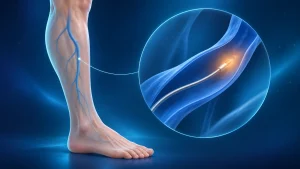
Do your legs feel heavy at the end of the day? Have you been told that blood flows backwards through one of your saphenous veins? If this is causing your symptoms, radiofrequency ablation for varicose veins may be an option. It involves closing the affected vein from within through a small puncture, using ultrasound guidance.
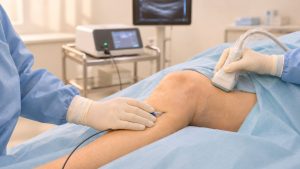
The assessment and duplex ultrasound scan take place in the clinic. If treatment is indicated, the procedure is performed in theatre, with an anaesthetist, as a day-case procedure. You can usually walk and return home on the same day.
In this guide, I explain how we determine whether the treatment may help you, what happens on the day and what results you can expect.
In this article
When can radiofrequency ablation help you?
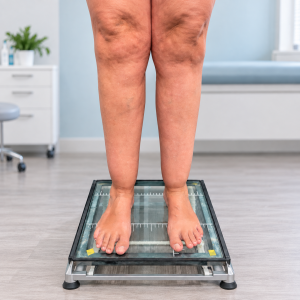
The veins in your legs have small valves that help blood return to the heart. If the valves in a saphenous vein, one of the superficial veins in the leg, stop closing properly, some of the blood flows backwards. This is called venous reflux. It may contribute to varicose veins, heaviness, pain, itching or swelling.
During the consultation, we assess your symptoms and use a vascular duplex ultrasound scan to examine blood flow and identify the source of reflux. Radiofrequency ablation may be a first-line option if a main vein such as the saphenous vein is causing symptoms and its anatomy allows treatment with a catheter. Skin discolouration, eczema or a venous ulcer also warrant assessment.

How is the treatment performed?
During the procedure, the anaesthetist monitors your condition and manages your anaesthesia.
- We locate the vein. Using ultrasound, we identify the segment to be treated and insert a very fine tube called a catheter through a small puncture.
- We administer local anaesthesia around the vein. Local anaesthesia helps reduce discomfort. The fluid surrounding the vein also protects nearby tissues from heat.
- We close the vein from within. The catheter applies controlled heat to the vein wall, closing the affected segment. Blood continues to return to the heart through the healthy veins.
If varicose tributaries also need treatment, foam sclerotherapy or removal through small incisions can be added. Depending on the individual case, this may be performed during the same session or later.
What results can you expect?
92 out of 100
This is the estimated proportion of saphenous veins that, in a European study, remained closed five years after radiofrequency ablation. Read the study.
Vein closure is confirmed using ultrasound. Improvement is also assessed by how you feel and which activities you can perform more comfortably. Studies generally report improvements in symptoms and quality of life. Over the years, varicose veins may develop in other veins as part of the natural progression of the condition.
Radiofrequency ablation, laser treatment and other options
Radiofrequency ablation and endovenous laser ablation close the vein using heat. In a review of studies, after one year approximately 93 out of 100 saphenous veins treated with radiofrequency ablation and 94 out of 100 treated with laser ablationremained closed. More recent comparisons also show similar quality-of-life outcomes. The choice depends, among other factors, on the anatomy of the vein, which other varicose veins need treatment and your preferences. 2024 review · 2026 review.
| Treatment | What you should know |
|---|---|
| Radiofrequency ablation | A catheter delivers controlled heat. The saphenous vein usually remains closed for years. |
| Endovenous laser ablation | A laser fibre delivers heat inside the vein. Closure rates are similar to those of radiofrequency ablation. |
| Ultrasound-guided foam sclerotherapy | Useful for varicose tributaries and selected cases involving the saphenous vein. With conventional foam, the main saphenous vein tends to reopen more frequently. |
| Conventional surgery | Allows the saphenous vein to be removed and can be effective. It may be an option if a catheter cannot pass along the vein. Recovery is generally longer. |
| Medical adhesive | A medical adhesive seals the vein without heat. In selected patients, closure rates are comparable. A local reaction to the material may occur. |
| Mechanochemical ablation | Combines a catheter with a liquid agent that helps close the vein without heat. It may cause less initial discomfort, although closure tends to be less durable. |
Related reading · A guide to sclerotherapy · How to choose a treatment for varicose veins.
What is recovery like?
You can usually get up, walk a little and go home on the same day. During the first few days, you may notice bruising, tightness or tenderness. When you return to your usual routine depends on how you feel, your activities and whether we have also treated varicose tributaries.
The team will advise you when you can drive or resume strenuous activities, whether you need compression stockings and how your follow-up will be arranged. Read more in our guide to walking after varicose vein treatment.
Serious complications are uncommon. These include deep vein thrombosis, which is the formation of a blood clot in a deep vein in the leg. Areas of numbness may also develop and are usually temporary; in rare cases, a skin burn can occur.
When to seek help. If you develop marked leg swelling or increasing pain after treatment, seek urgent medical assessment. If you experience sudden shortness of breath or chest pain, call 112.
Frequently asked questions
Is the treatment painful?
You may feel the injection of local anaesthetic or some pressure. If you feel pain at any point, tell the team so that the anaesthesia can be adjusted.
Will visible varicose veins disappear?
Some tributaries become less visible once reflux has been corrected. Others need additional treatment, such as foam sclerotherapy or removal through small incisions.
Is it suitable for spider veins?
If you have only fine veins and there is no reflux in a main vein, other treatments such as sclerotherapy are usually considered.
Radiofrequency ablation for varicose veins in Barcelona
For more than 12 years , we have been carrying out this treatment and have treated more than 10,000 patients. During the consultation, we review your symptoms and duplex ultrasound findings to explain which options suit your case and what you can expect from each one.
Do you have questions about radiofrequency ablation?
Find out more about this treatment: Radiofrequency ablation. If you have questions about the procedure or recovery, you can write to us through our contact page.
Other sources of information
- Cochrane · Comparison of treatments for varicose veins (in Spanish).
- European Society for Vascular Surgery · Guidelines on chronic venous disease.
- Scientific Reports · Comparison of techniques in 27 trials, 2026.
- Lawaetz and colleagues · Five-year comparison of four techniques.
- Wen and colleagues · Medical adhesive versus radiofrequency ablation, 2026.
- Cheng and colleagues · Mechanochemical ablation versus radiofrequency ablation, 2026.
- Cambridge University Hospitals · Information on radiofrequency ablation and recovery.