Endovenous treatment
Since 2000, with the development of new endovenous techniques, thermal ablation of the great or small saphenous vein has become a central approach to the treatment of lower-limb varicose veins. Because of its safety, effectiveness, cosmetic results and minimal tissue trauma, varicose vein treatment using radiofrequency ablation (RFA) is currently our treatment of choice for most patients in private practice.
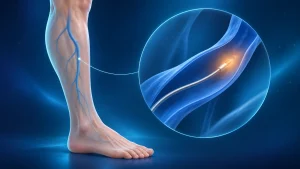
Radiofrequency ablation uses radiofrequency energy to cause cellular injury and alter or destroy tissue through heat generation. Radiofrequency energy applied to tissue produces heating. The aim is to achieve fibrotic occlusion of the pathological vein, followed by shrinkage. Heat generated by the catheter in contact with the inner vein wall damages the venous tissue and leads to thrombus formation within the lumen, closing the vessel. Over the following weeks or months, the body processes the damaged tissue and replaces it with residual fibrous scar tissue, causing the treated vein (great or small saphenous vein) to disappear.

Endovenous treatment procedure
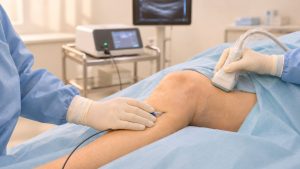
The entire procedure is carried out under ultrasound guidance by an experienced, qualified vascular surgeon skilled in ultrasound, because surrounding tissues must be protected using tumescent anaesthesia around the treated saphenous vein and the correct positioning of the radiofrequency catheter must be monitored. Periodic clinical follow-up is also necessary to confirm successful results and vein closure, so we recommend appointments at one month, 3 months and 6 months after the procedure.
In a European multicentre cohort study involving 295 limbs, radiofrequency ablation achieved a great saphenous vein occlusion rate of 92% and a reflux-free rate of 95% at five years. In the Varico 2 study, comparing RFA with laser treatment using radial-tip fibres, occlusion rates were similar in both groups, 96% and 97%, respectively (p = 0.81)*. There was no difference in postoperative pain scores, and the median time to return to work was one day. Patients in both groups reported substantial clinical improvement, with results lasting five years. In most studies, complication rates after RFA were very low, with rare thrombotic events (0.3% DVT), occurring at a similar rate to those after laser treatment.
In our experience, potential complications of the procedure are minimal and, when they occur, are generally manageable and short-lived. These include bruising at the puncture site, paraesthesia and tightness in the thigh. Other potential complications, such as thrombophlebitis of the treated vein and burns, have been described, but are rarely encountered. In our experience (more than 5,000 RFA procedures), we have never seen a burn. Deep vein thrombosis is also very uncommon, with a reported rate of 0.3% in the Varico 2 study**.
Treatment of varicose veins using radiofrequency ablation is safe and effective when the underlying cause is saphenous reflux. Long-term outcomes are comparable to those of conventional surgery, with the advantages of faster recovery, less pain and improved quality of life.
* J.A. Lawson, S.A. Gauw, C.J. van Vlijmen, P. Pronk, M.T.W. Gaastra, M.J. Tangelder et al. Prospective comparative cohort study evaluating incompetent great saphenous vein closure using radiofrequency-powered segmental ablation or 1470-nm endovenous laser ablation with radial-tip fibers (Varico 2 study). J Vasc Surg Venous Lymphat Disord, 6 (2018), pp. 31-40.
** D.A. Healy, S. Kimura, D. Power, A. Elhaj, Y. Abdeldaim, K.S. Cross et al. A systematic review and meta-analysis of thrombotic events following endovenous thermal ablation of the great saphenous vein. Eur J Vasc Endovasc Surg, 56 (2018), pp. 410-424.