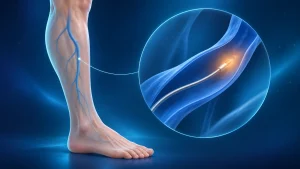
Impaired venous return from the lower limbs.
What causes varicose veins?
The arteries supply oxygen to the body's organs and tissues, while the veins return deoxygenated blood to the heart.
Several mechanisms help overcome gravity to achieve venous return. When one of these mechanisms fails, blood pools in the veins, their walls dilate and their structure and function are altered, leading to symptoms.
How is venous insufficiency diagnosed?
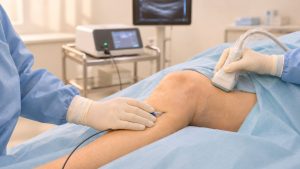
Physical examination is usually sufficient to identify varicose veins and signs of venous or lymphatic insufficiency, although additional information is needed.
For this reason, additional investigations are available. One of the most informative is duplex ultrasound with colour flow imaging.
In some cases, contrast venography is necessary.

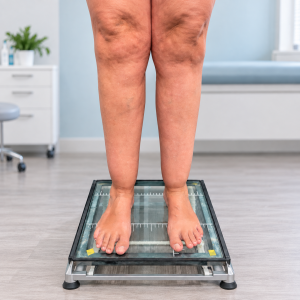
Photographs of one of our patients who had undergone unsuccessful surgery on 4 occasions at another centre. Final result after 5 sessions of foam sclerotherapy.
How are varicose veins treated?
There is currently no definitive treatment that completely reverses damage to the venous system. However, chronic venous insufficiency and its complications can be prevented from worsening and managed over time.
Compression stockings are perhaps the most important part of treatment, as they help support venous return when affected veins cannot perform this function adequately.
A range of venoactive drugs is available to improve venous function and relieve symptoms.
The use of varicose vein surgery has long been recognised as an effective treatment with favourable outcomes, although it is not always indicated and may not be sufficient. A complete assessment of the underlying cause in each case is therefore necessary. On this basis, we can formulate a treatment plan, potentially combining several techniques in the same session, including:
- Foam sclerotherapy
- Endovenous thermal ablation (radiofrequency, laser)
- Mechanochemical ablation (ClariVein, Flebogrif)
- Cyanoacrylate adhesive closure (VenaSeal)