What are the main venous trunks?
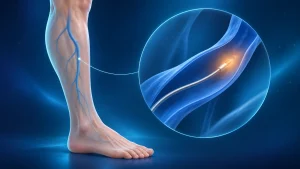
The venous system of the lower limbs is divided into superficial and deep systems. Superficial veins lie beneath the skin in the subcutaneous fat. They include the two main trunks, the great and small saphenous veins. When these become incompetent, they give rise to the visible varicose veins of truncal origin (large and bulging), which are ultimately their tributaries. The deep system consists of veins situated deeper in the tissues, generally alongside bones or muscles, and is not usually the target of treatment for lower-limb varicose veins.
What is the aim of treating the major venous trunks?
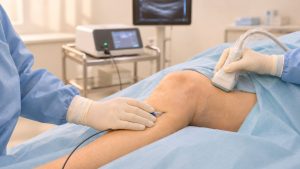
The aim of truncal vein sclerotherapy is to ablate the affected trunk, whether the great saphenous vein, the small saphenous vein or both. This eliminates the source of reflux-related overload in the superficial venous system and allows visible varicose tributaries to be treated. In some patients who have previously undergone saphenous vein surgery, recanalisation of interrupted segments or irregular neovascularisation may occur for reasons that remain incompletely understood. This can lead to substantial recurrent varicose veins that are difficult and potentially hazardous to treat surgically. We therefore consider foam sclerotherapy the best option in such cases.
Reported effectiveness of ultrasound-guided foam sclerotherapy with polidocanol for major venous trunks exceeds 80% with a single treatment session. Several sessions can increase effectiveness to over 90%.
What does sclerotherapy involve?
Truncal vein sclerotherapy involves injecting a foamed sclerosant (polidocanol), which causes inflammation of the vein wall and thrombosis of the treated vein. Fibrosis (scarring along its course) then occurs and the vein gradually disappears. In your case, given the characteristics of the varicose veins you have, we consider sclerotherapy the most appropriate treatment.
During the first few days, you may notice that the veins look darker and the overlying skin is red. The area may be painful. During the following days and weeks, it is normal for the area to feel firm and raised. This discomfort may take several weeks to settle. Eventually, only a firm treated vein may remain, which can take several months to disappear.
Treatment is performed on an outpatient basis (no hospital admission).
After the session, dressings and a compression stocking should be applied to the treated leg. Your doctor will explain when and how to use them and for how long.
After sclerotherapy, you should attend a follow-up appointment within a few days to assess the results and determine whether further sessions are needed.
What effects and complications may occur?
Every procedure or intervention has potential effects and complications. In general, these are minor and resolve or improve over time.
In all cases or commonly:
In all cases or commonly:
Pain or discomfort during treatment or in the following days, usually improving spontaneously within a short period.
Areas of inflammation of the skin around the treated veins, which also tend to improve within a short period.
Pigmentation of treated areas. This is usually mild pigmentation that fades spontaneously over time (months). In some cases, depigmenting creams may be recommended.
Uncommon risks
Allergic reactions to the sclerosant (very rare). Always tell your doctor about any medication allergies. An allergic reaction to a medicine may range from urticaria to much more severe and, fortunately, exceptional manifestations that could be life-threatening.
Pulmonary embolism secondary to thrombosis of the treated venous trunk. This is an extremely rare complication (a study of 1,124 patients reported a 0% rate of pulmonary embolism) [1].
Infection at injection sites.
Significant haematoma (very rarely, drainage may be indicated).
Small areas of skin necrosis. Small ulcers may develop, although this is also very rare. They heal leaving a small scar.
Some varicose veins may remain, and new veins (particularly small ones) may appear, forming reddish marks that are difficult to treat.
Complications may necessitate further procedures to address them. If they occur, you and/or your family will be informed as soon as possible about the complication and the measures proposed or taken to resolve it.
Are there alternatives to treatment?
If we recommend this procedure, it is because, after assessing the risks and benefits, we consider it the most appropriate technique for your condition and expect improvement after treatment.
If you decide not to undergo treatment, we will recommend periodic medical reviews. You should also wear compression socks or stockings and follow lifestyle advice. Medication may occasionally be indicated, particularly during hot weather. We remain available should you need us, if complications arise or if you change your mind and decide to proceed with treatment.
In our view, neither conventional surgery nor CHIVA is the most appropriate treatment in your case. Sometimes treatment options are limited by the size of the varicose veins. Laser ablation and other similar treatments may be complementary in some cases, but have not been considered the best option for you.
[1] JA Nigro, A Conde. Tratamiento con escleroterapia ecodirigida con espuma. Performance terapéutica a los 10 años. FLEBOLOGÍA Y LINFOLOGÍA – LECTURAS VASCULARES / AÑO 9 – Nº 22 / ENERO – ABRIL 2014. pp. 1373-85.