Totally implantable venous access port (Port-a-Cath)
In this article from Varices Barcelona we explain what a Port-a-Cath is. Although “Port-a-Cath” is widely used to describe a totally implantable venous access device, it is actually the trade name of one particular brand, registered by Smiths Medical, a pioneer in its development. Today it is often simply referred to as a port. The device has represented an important advance in care for both patients and healthcare professionals. Patients can avoid repeated needle punctures for intravenous access and the associated complications, while healthcare professionals have reliable, long-term central venous access without repeatedly undertaking central venous cannulation.
What is a Port-a-Cath and what is it used for?
A Port-a-Cath consists of a catheter connected to a small reservoir or port. It is designed to be implanted entirely beneath the skin, allowing easy, rapid and reliable long-term access to the central venous system. The catheter tip is positioned in a large vein, usually the superior vena cava, and the port at the other end is placed beneath the skin of the chest, usually within the subcutaneous fat. Healthcare professionals access this reservoir for various purposes, including administering intravenous medicines or nutrition and taking blood samples.


Indications for implanting a venous access port
The indication for a Port-a-Cath is usually determined by the oncologist, haematologist or physician caring for patients with chronic conditions who require continuous or repeated access to the central venous system. It is commonly indicated for patients who need:
Chemotherapy in hospital or a day unit
Chemotherapy at home
Frequent blood sampling over prolonged periods
Long-term administration of medicines such as antibiotics
Infusion of blood products (platelets, clotting factors and blood)
Administration of parenteral nutrition

How is a Port-a-Cath implanted?
Implantation requires a minor surgical procedure performed by a surgeon specialising in the vascular system (usually a vascular surgeon) in the operating theatre under local anaesthesia and light sedation, with an anaesthetist present for patient comfort. This approach is used for most patients. General anaesthesia may be necessary in exceptional cases.
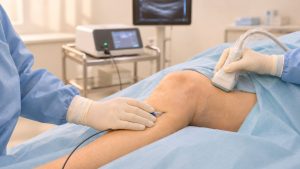
Before the procedure, potential venous access routes must be carefully assessed using duplex ultrasound and the medical history to avoid unexpected findings on the day of implantation, such as subclavian or jugular vein thrombosis following previous catheters or absence of a suitable cephalic vein. Routine preoperative investigations are also needed to assess blood clotting (platelet count and clotting factors), exclude relevant thoracic anatomical abnormalities or lung disease (chest X-ray) and allow preoperative assessment by the anaesthetist.
The port is usually placed on the front of the chest, a few centimetres below the clavicle over the pectoral muscle. Occasionally it may be implanted at the front of the patient's arm. The catheter tip should be positioned in the superior vena cava near its junction with the right atrium of the heart. This is monitored throughout the procedure using intraoperative imaging.

Patient with a correctly implanted Port-a-Cath.
This is a day-case procedure. Once appropriate catheter positioning and function have been confirmed, complications excluded and the patient has recovered from sedation, they are discharged home. Sutures often do not need to be removed because absorbable sutures are used.
Port-a-Cath care
The aim of port care is to prevent infection and catheter lumen occlusion due to thrombosis. Nursing staff should therefore follow appropriate precautions and protocols when handling the device.
- Hand hygiene with antiseptic solutions and sterile gloves, together with disinfection of the skin over the port reservoir
- Use appropriate fine port-access needles of sufficient length to reach the base of the reservoir. Avoid repeatedly puncturing the same point and distribute punctures across the septum.
- When administering several medicines in succession, flush the port and catheter with 0.9% saline.
- Before administering treatment, check for obstruction by aspirating the catheter and verify correct function by injecting saline. If pain, resistance or swelling around the reservoir is observed, stop administration immediately.
- At the end of treatment, flush the device with 20 mL of normal saline and then lock it with heparinised saline.
- If continuous infusion of a medicine is required, change the needle every 48 hours.
- If signs of inflammation occur at the port site (swelling, pain, redness, warmth or discharge), do not use the catheter and inform the doctor promptly.
- When the catheter is not being used, it should be flushed with heparinised saline every 4–7 weeks.
Frequently asked questions
Will having a Port-a-Cath restrict me in any way?
No. Patients can lead a normal social and working life within the limitations of their underlying condition. Except in very thin patients, the port is barely visible; in these patients a small lump may be noticeable on the front of the chest. It does not normally cause pain or restrict arm movement unless a complication such as thrombosis or infection occurs.
When can the Port-a-Cath be used?
Once implanted and correct catheter positioning has been confirmed, it can be used on the day of insertion. Your oncologist will tell you when the first use is scheduled.
How long can I keep the device in place?
This depends on whether the device is still needed and should be decided by the doctor treating your condition. The device can remain in place for years; there is no fixed duration. If it is not used for a prolonged period, maintenance is required every 4–7 weeks.
When will my Port-a-Cath be removed?
As explained above, if the catheter functions properly and there are no complications, the physician responsible for your care determines whether removal is necessary. Some complications require removal, while others do not. The removal procedure is performed under sedation and local anaesthesia.
Will airport metal detectors sound?
Some ports contain a titanium metal structure and may activate airport metal detectors. You should inform security staff.
Are there any exercises that may help me?
In general, no specific exercise is required to maintain a Port-a-Cath, but the following exercises have been found beneficial:
- Turn your head to look to each side. Repeat 10 times.
- Raise and lower your shoulders 10 times.
- Extend your arms out to the sides and raise the arm until it reaches your head.
- Looking straight ahead, tilt your head to the right and left 10 times.
- Looking straight ahead, tilt your head forwards, gently bringing your chin towards your chest, then return to the starting position. Repeat 10 times.